Hyper-ion HJT modules earn TÜV Rheinland’s top AAA anti-glare rating
Tested to TÜV Rheinland’s 2 PfG 3146 anti-glare standard, Risen’s Hyper-ion heterojunction module measured a DGP of 0.30 against the 0.35 AAA limit, opening the way for solar near airports and highways.
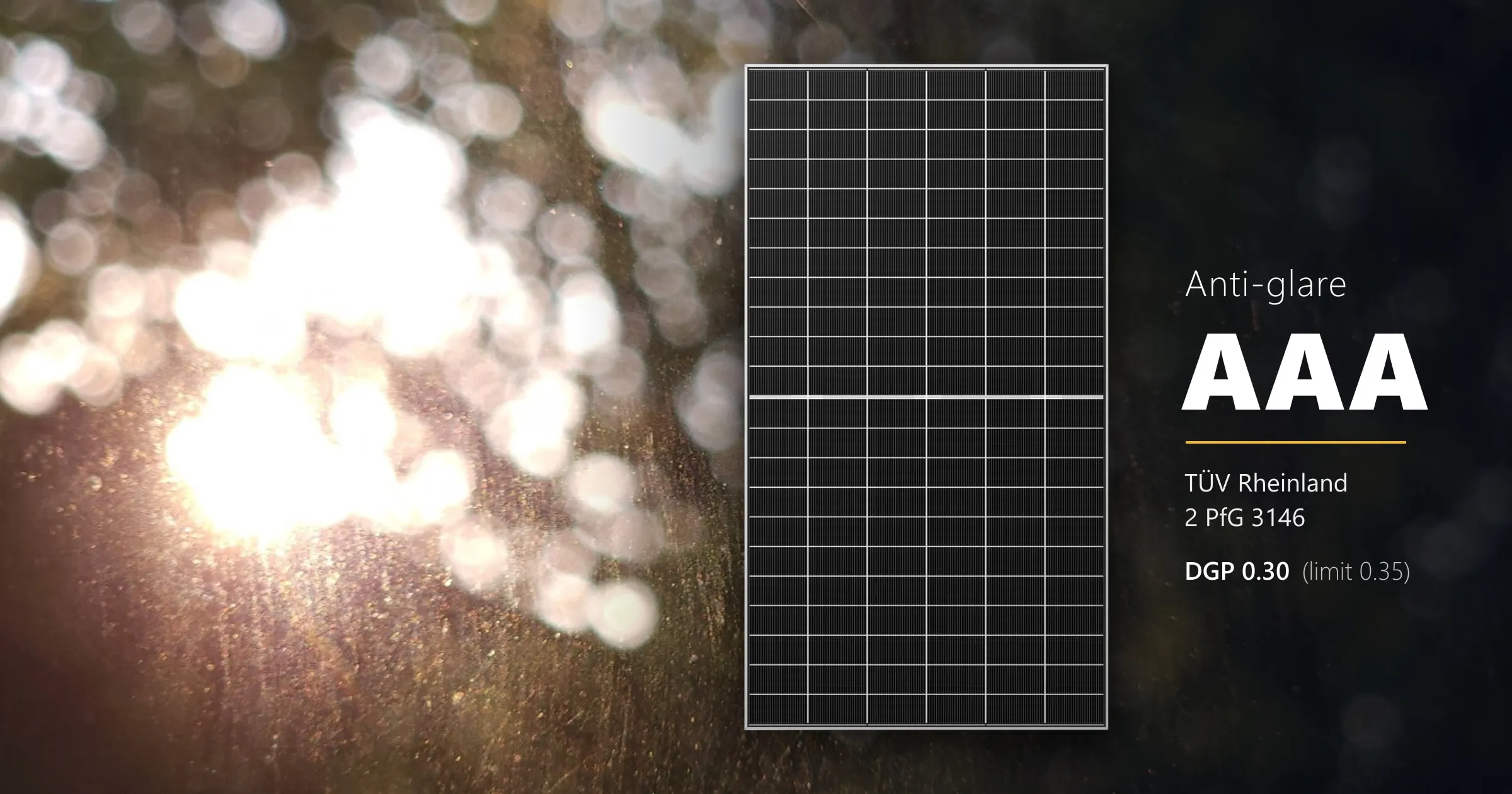
Solar farms are increasingly built beside highways and around airports. That raises a real safety question: can glare from the modules distract drivers or pilots? For projects in these transport-sensitive areas, glare has become a key hurdle.
Risen’s Hyper-ion heterojunction (HJT) module has now earned the highest AAA rating under TÜV Rheinland’s 2 PfG 3146 anti-glare standard, which Risen describes as the world’s first quantified test standard for glare from PV modules. In a two-part interview, Song Yifeng, Product Director in Risen’s PV and storage product department, and Marc, TÜV Rheinland’s anti-glare specialist for PV products in Greater China, explained what the rating measures and how Hyper-ion achieves it.
How the standard measures glare
2 PfG 3146 turns the question “is it dazzling?” into measurable safety criteria. It assesses glare on two main measures:
- Daylight glare probability (DGP), which rates visual comfort
- Disability glare luminance, which sets the safety line for traffic
Hyper-ion’s results
All testing was done in TÜV Rheinland’s laboratory, and the data is complete and traceable. Risen says the results can go straight into compliance reviews for projects in sensitive areas such as airports and highways.
- DGP of 0.30, better than the 0.35 limit for the AAA grade
- Maximum glare luminance of 3463.94 cd/m², well under the 20,000 cd/m² safety threshold
- Maximum specular reflectance of 0.85% across all angles, which sharply reduces the risk of mirror-like reflections
Optical performance stayed stable across all angles, giving these projects a generous safety margin.
Two layers against glare
Many anti-glare products only frost the surface of the glass. That deals with reflection at the surface but not with light bouncing back from inside the cell, which can still cause bright halos.
Hyper-ion instead tackles glare at two layers along the light’s whole path:
- Outer layer: nano-textured glass. A chemically etched micro-structure turns strong directional light into soft, diffuse reflection. The surface also resists dust build-up, which makes cleaning and maintenance easier.
- Inner layer: busbar-less cells. The cells’ optics are tuned to reduce reflection and absorb more light, so less of it bounces back out.
Low glare without giving up yield
A question customers often ask is whether lower reflection means lower output. According to Song, Hyper-ion’s optical design reaches top-grade anti-glare performance while keeping the module’s generating capability, and it eases the maintenance load. That balances compliance, O&M cost and energy yield over the project’s life.
What comes next
TÜV Rheinland’s expert expects anti-glare assessment to move beyond single modules towards array-level and real-site evaluation. Risen says the AAA rating is not the finish line. It plans to keep improving its optical technology and work with certification bodies on industry standards, so solar can be built safely along highways and near airports.
Find out more about Risen’s Hyper-ion modules or explore the full range of solar modules →.
Adapted from two Risen Energy Co., Ltd. announcements, of 30 October and 4 November 2026.