Explainer
HJT, explained.
Heterojunction (HJT) is the cell technology behind Risen’s premium modules, from the all-black RisenSpace on Australian homes to Hyper-ion on solar farms. Here’s how it works and why it matters on your roof, in plain English.
- 01
What is a heterojunction cell?
Most solar cells are built from a single kind of silicon. A heterojunction (HJT) cell combines two: a crystalline silicon wafer at the core, coated on both faces with ultra-thin layers of amorphous silicon. The word “heterojunction” simply means the junction between those different materials.
Those coatings matter because the surface of a silicon wafer is where much of the energy is lost. In Risen’s HJT cells the design is symmetrical, with full-area passivation on both sides, which seals the surfaces so fewer electrical charges are lost before they can be collected. That shows up as a high open-circuit voltage: 754 mV in Risen’s cells.
- 02
Why it keeps its output in the heat
Every solar panel loses some output as it warms up, and Australian roofs get hot. The temperature coefficient measures that loss for each degree above 25°C. Risen’s RisenSpace HJT module is rated at −0.24%/°C, against −0.26%/°C for back-contact (BC) and −0.29%/°C for TOPCon modules in Risen’s comparison.
On a hot day a panel can run 40°C above that 25°C test temperature. At −0.24%/°C that costs about 9.6% of rated output, compared with about 11.6% at −0.29%/°C: two extra percentage points of power at exactly the time of day when the sun is strongest.
- 03
Power from both sides
Because the cell is the same on both faces, HJT is naturally bifacial: light reflected onto the back of a dual-glass module also turns into power. Risen’s HJT module has a bifacial factor of 90% ±5%, meaning the rear side works at around nine-tenths of the front’s efficiency. In Risen’s comparison that is ahead of TOPCon (80%) and BC (75%).
How much extra energy that brings depends on the installation: how high the panels sit and how much light the surface beneath them reflects.
- 04
Strong at dawn, dusk and under cloud
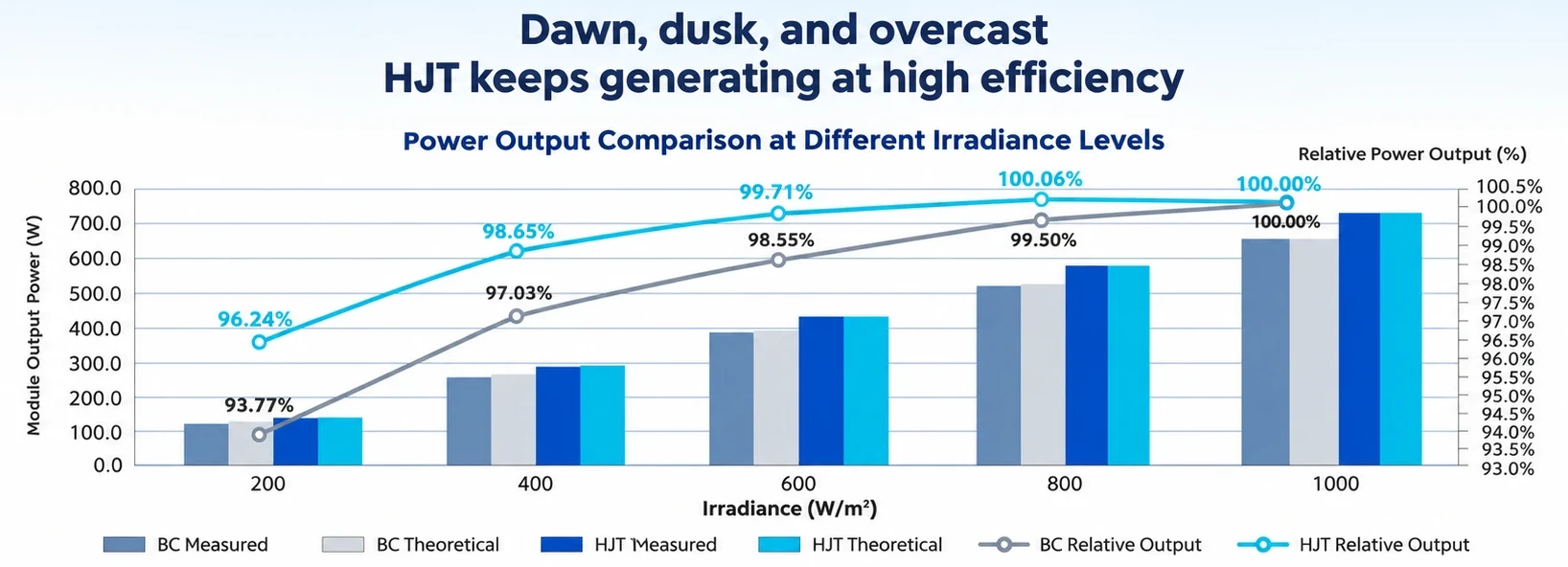
Panels spend much of the day in weaker light than the bright sun they are rated in. In Risen’s measurements at 200 W/m², roughly the light of early morning or a heavily overcast sky, an HJT half-cut module kept 96.24% of its relative output, compared with 93.77% for a BC half-cut module.
That gives an earlier start in the morning and longer output into the evening, which adds up over a year.
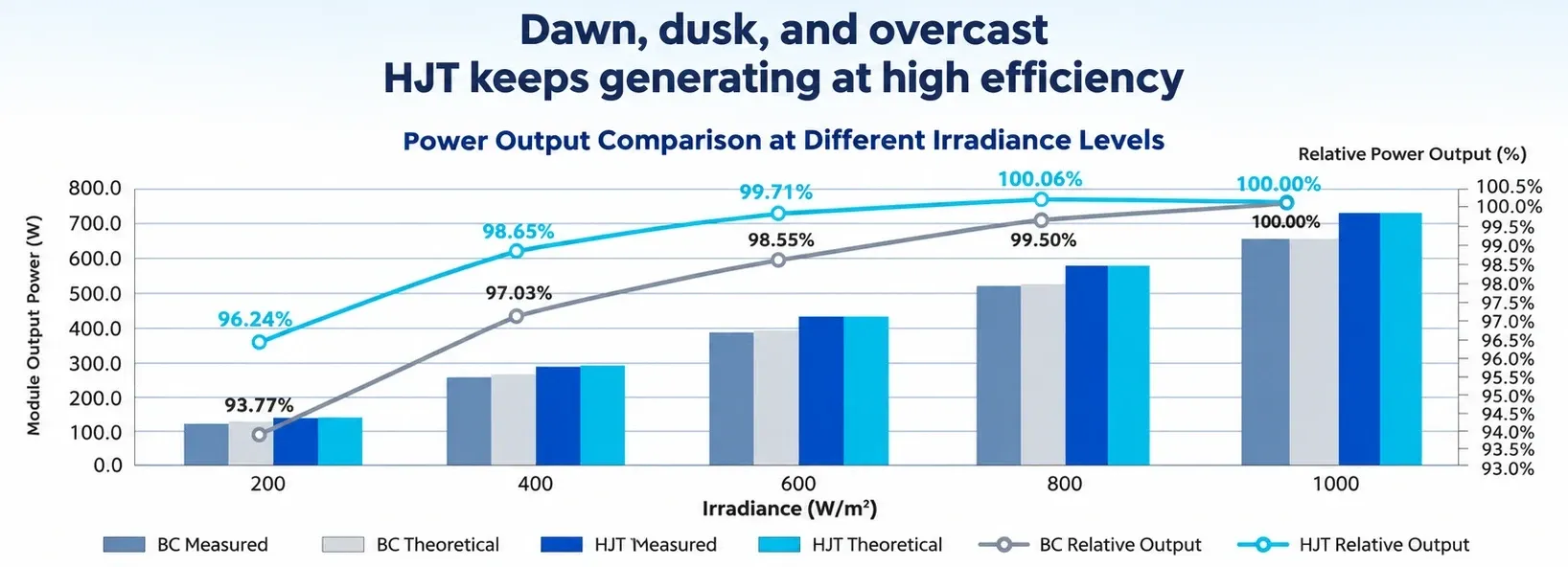
Risen’s measurements of HJT and BC half-cut modules at different light levels (RisenSpace product information, October 2026). Tap to open full size. - 05
Slow ageing, backed for 40 years
All panels lose a little output each year. Risen’s RisenSpace HJT module is warranted to degrade by just 0.30% a year after the first year, so it still guarantees 90.3% of its rated power at year 30. In Risen’s comparison, TOPCon and BC rooftop modules sit at 0.35–0.40% a year.
On Australian and New Zealand rooftops it carries dual 40-year warranties: a 25-year product warranty plus a free 15-year extension, and a 30-year linear power warranty plus a free 10-year extension.
| HJT | BC | TOPCon | |
|---|---|---|---|
| Temperature coefficient | −0.24%/°C | −0.26%/°C | −0.29%/°C |
| Bifacial factor | 90% ±5% | 75% | 80% |
Inside Risen’s HJT
Six technologies in every cell and module.
-
Ultra-thin cells
Risen mass-produces HJT cells around 95 μm thick, thinner than a sheet of paper, without giving up strength.
-
Zero-busbar (0BB) cells
Dropping the wide busbars from the front of the cell means less shading and more light reaching the silicon.
-
Hyper-link interconnection
A stress-free way of connecting cells that helps the thin cells resist micro-cracks.
-
TCO 2.0
An improved transparent conductive layer that lets more light through to the cell.
-
UV down-conversion
Converts ultraviolet light, which can age a module, into light the cell can turn into electricity.
-
High-adhesion encapsulation
A film made for HJT that keeps the module sealed against moisture and ageing over its long life.
Risen has been first to several HJT milestones, including the first HJT modules with 158.75 mm and 210 mm cells and the first HJT module above 700 W. See the world firsts
FAQ
Common questions.
What does HJT stand for?
Heterojunction technology. It describes a solar cell that joins two kinds of silicon: a crystalline silicon wafer coated on both sides with thin layers of amorphous silicon.
Why do HJT panels suit Australian conditions?
They lose less output as they heat up (a −0.24%/°C temperature coefficient on Risen’s RisenSpace module), they generate well in low morning and evening light, and their symmetrical, bifacial design adds energy from reflected light.
How is HJT different from TOPCon?
Both are n-type cell technologies. HJT uses thin amorphous silicon layers on both faces of the wafer, which gives a symmetrical, naturally bifacial cell. In Risen’s comparison, its HJT module has a lower temperature coefficient, a higher bifacial factor and slower annual degradation than TOPCon.
Which Risen modules use HJT?
For homes, the all-black RisenSpace (RSM90) rooftop module at up to 500 Wp. For solar farms and large commercial projects, the Hyper-ion range of large-format HJT modules.
See HJT on a real roof.
Explore the all-black RisenSpace rooftop module, or find an installer near you.